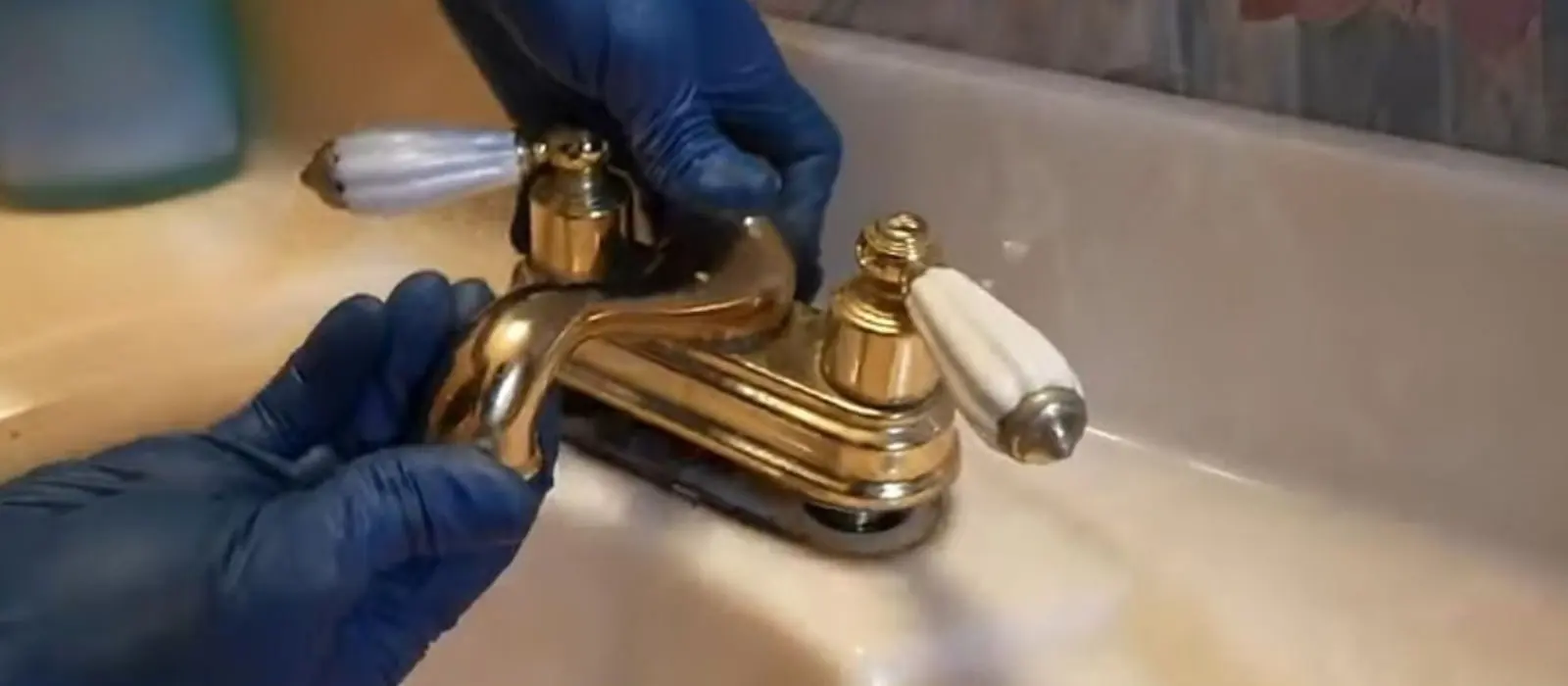
A leaking bathroom faucet almost always comes down to one worn part inside the handle. A drip from the spout means the cartridge, ceramic disc or seat is worn. Water around the base of the spout or under the handle means a cracked or flattened O-ring. Shut the water off at the small valves under the sink first, then work out which part has failed.
This guide explains how each faucet type leaks, how to find the cause, what a careful homeowner can do, and when a licensed plumber is the better call. It also covers the mistakes that turn a ten dollar part into a damaged sink.
Match the leak to the part
Dry the faucet and the counter with a towel, close the handle firmly and watch where the first drop appears. That spot tells you more than the brand name does.
A bathroom faucet has only a few moving parts. When you know which one is wearing, you can buy the right replacement the first time instead of guessing.
Drip from the spout
Water passes the valve even when the handle is closed. On a compression faucet, the rubber washer and seat are worn. On a cartridge or ceramic disc faucet, the cartridge or its seals are worn, or grit is holding the disc open.
Leak at the base of the spout
Swiveling spouts seal with O-rings. These dry out and flatten, and water seeps down the outside of the faucet body onto the counter and into the cabinet.
Leak at the handle
Water working up around the handle points to the cartridge stem, a loose retaining nut or a worn seal in a single-handle faucet.
Weak flow or a handle that is hard to turn
Mineral buildup in the aerator or cartridge can restrict water and bind the handle. MDC does not publish a hardness figure, so test your tap if you see white scale often.
Faucet types and what usually wears out
Look at the handles. Two handles and a stem often mean compression. A single lever usually means a cartridge or a ceramic disc.
| Faucet type | Common leak | Part to replace | Typical difficulty |
|---|---|---|---|
| Compression (two handles) | Drip from spout | Washer and seat | Easy to moderate |
| Cartridge (single or double) | Drip or leak at the handle | Cartridge and O-rings | Moderate |
| Ceramic disc (single lever) | Drip from spout, stiff lever | Disc cartridge and seals | Moderate |
| Widespread or three-piece | Leak at the base or connection | O-rings, supply lines or faucet | Moderate to hard |
Shutoffs and first steps
Every sink should have two small shutoff valves under it, one for hot and one for cold. Turn each clockwise until snug.
Before you open the faucet
- Close both valves under the sink, then open the faucet to release pressure and drain the line.
- Plug the sink drain with a rag so a screw or small part cannot fall down it.
- Lay a towel in the bowl to protect the finish.
- Take a photo of the faucet before you take it apart so reassembly is easy.
- If a shutoff will not turn or drips when turned, stop. That valve needs replacing and the main water supply is the next option.
How a cartridge or disc faucet is repaired
Remove the handle
Pry off the cap, remove the screw and lift the handle. Some use a set screw on the side.
Take out the retaining nut and cartridge
Loosen the nut with a wrench wrapped in cloth, then pull the cartridge straight up. Note its direction first.
Replace the cartridge and O-rings
Match the new part to the old one. Coat the new O-rings lightly with plumber's grease.
Clean the faucet body
Wipe out sediment and scale. Clean the aerator at the spout tip while you are there.
Reassemble and test
Tighten the nut, reinstall the handle, then open the shutoffs slowly. Run both hot and cold and check under the sink.
Common repair mistakes
Mistakes that damage the faucet or the sink
- Not shutting off the water first and flooding the cabinet.
- Cranking a wrench on chrome and scratching the finish.
- Installing the cartridge in the wrong direction.
- Overtightening the nut until the handle binds.
- Reusing hardened old O-rings.
- Ignoring a leak under the sink until the cabinet floor swells.
When to call a plumber instead
Call if the shutoff valves will not close, if the supply lines are corroded, if a new cartridge does not stop the leak, or if the faucet is old enough that parts are no longer made. Replacing the whole faucet is often the better value at that point.
Water in the cabinet is a second reason to call. A slow leak under a vanity can rot the cabinet floor and wet the subfloor before you notice. Our faucet repair service handles bathroom and kitchen faucets, supply lines and shutoffs, and our line takes urgent calls 24/7.
If the leak is from a toilet, tub or shower rather than the sink, see our toilet repair page for the toilet side.
What affects the cost of a faucet repair
You get a clear price before work starts. The number depends on a few things.
What moves the price
- Repair or replace: a cartridge swap is smaller than a new faucet.
- Parts: older or specialty brands cost more and may need ordering.
- Shutoffs and supply lines: replacing them adds parts and time.
- Cabinet and sink condition: damage found while working can add to the job.
- Time of the call: nights, weekends and holidays are usually priced differently.
Rocky Hill water and older fixtures
MDC supplies water in Rocky Hill, and its 2025 water quality report lists an average pH of 7.41 with corrosion control to keep pH above neutral. MDC's lead-safety note also says hot water may carry more minerals than the cold water it supplies.
For you, that means hot-side parts and aerators may collect scale sooner than cold-side ones. Clean the aerator when flow drops, and ask MDC at (860) 278-7850 about your water. With homes here mostly built in the 1960s to 1980s, original faucets and shutoffs are common.
Source type: utility water quality report, town planning document
Water running into the cabinet right now?
Close the shutoffs under the sink. If they will not close, turn off the main water valve and call. Do not reach into a cabinet with standing water near outlets or a power strip.
Questions homeowners ask
Why is my bathroom faucet dripping after I turn it off?
A worn washer, cartridge or ceramic disc is letting water past the valve. Grit can also hold the disc open. Replacing the worn part usually stops it, and cleaning the faucet body helps the new part last.
Why is water leaking at the base of my faucet?
The O-rings that seal the swivel spout or the base are likely cracked or flattened. Replacing them is simple on most faucets. If the base is corroded or the faucet body is cracked, replace the faucet.
Can I fix a leaky faucet myself?
Often yes. Shut off the water, take the faucet apart, and match the new cartridge or O-rings to the old ones. Stop and call if a shutoff will not close, parts are seized or you are unsure what you are looking at.
How do I know if I need a new faucet?
Replace it when the body is cracked, the finish is peeling to bare metal, parts are not available or repairs keep failing. A faucet that leaks again soon after a new cartridge often has a worn body or seat.
What if the shutoff valves under the sink will not turn?
Do not force them. Use the main water valve, then call a plumber. Old stop valves often leak or break when turned, and replacing them first makes the faucet repair safer.
Do you repair bathroom faucets in Rocky Hill?
Yes. We repair and replace bathroom faucets, shutoffs and supply lines in Rocky Hill, and our 24/7 line takes urgent calls when a leak is running into a cabinet. We give a clear price before work starts.
Call the 24/7 line, describe the problem, and we confirm what it will cost before any work starts.