If your water heater has stopped making hot water, is dripping, or is making loud banging sounds, call us now. Dispatch runs 24/7, and same-day appointments are available when schedules allow. Before you call, find the shutoff valve on the cold water pipe above the tank and note whether the tank is gas or electric. That one detail speeds up the diagnosis.
Repairs on a tank heater usually come down to a short list of parts: a pilot assembly or igniter, a heating element, a thermostat, a valve or a connection. Some failures are cheap to fix. A tank that leaks from its own shell is different, because the steel has failed and the repair is a replacement. We tell you which one you have before work starts.
What to do right now if your water heater fails
Start with your nose. If you smell gas near a gas heater, or any rotten-egg odor, leave the building at once and call 911 or your gas utility's emergency line from outside. Do not flip switches, light anything or hunt for the source. Gas problems are not a repair job for a homeowner.
If there is no gas smell, the next question is water. A heater that is actively leaking can flood a basement or closet in an hour or two. A heater that simply has no hot water can usually wait for a plumber while the house stays dry and safe.
While you wait for the plumber
- Smell gas or feel dizzy near a gas heater? Get everyone outside and call 911 or the gas utility emergency line. Carbon monoxide has no smell and can cause headache, nausea and confusion.
- If the tank is leaking, close the cold water shutoff valve on the pipe above the heater. Turn it clockwise until it stops.
- On an electric heater, switch off its breaker if you can reach the panel without stepping in water. If the floor is wet, stay out and call.
- On a gas heater, turn the gas control to off only if the dial is easy to reach and there is no gas smell. Never relight a pilot you cannot see.
- Move boxes and stored items away from the base, and put a bucket under any drip. Do not open the drain valve on a hot tank. Water at that temperature can scald.
Symptom, likely cause and what happens next
Most calls fit one of these patterns. The plumber confirms the cause on site before suggesting anything.
| What you see | Common cause | Usual next step |
|---|---|---|
| No hot water at all, gas heater | Pilot out, failed thermocouple or flame sensor, or a gas control problem | Test the safety parts and replace the failed one if the tank is sound |
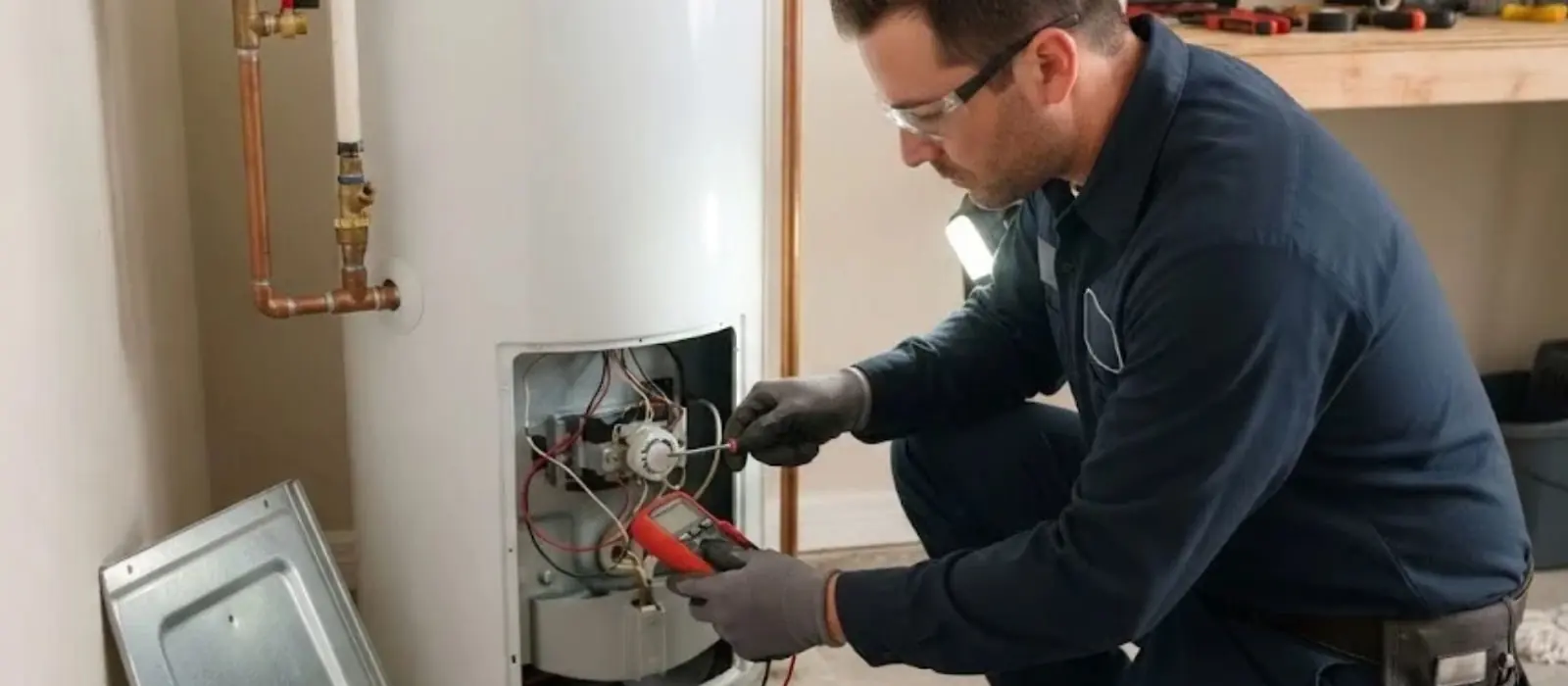
| No hot water at all, electric heater | Tripped high limit, failed element or thermostat, or a breaker problem | Test with a meter and replace the failed part |
| Warm but not hot, or runs out fast | One failed element, a dip tube problem or heavy sediment | Replace the element or tube, or flush the tank |
| Water pooling at the base | Leaking fitting, valve or the tank shell itself | Find the exact leak point, then repair or replace |
| Banging, popping or rumbling | Sediment hardened at the bottom of the tank | Flush the tank, or plan replacement if it is old |
| Hot water with a rotten smell | Bacterial reaction with the anode rod in the tank | Flush, then replace the anode rod if the tank is sound |
Gas heaters: pilot, igniter and flame sensor
A gas heater makes heat with a small flame that must stay lit. If a standing pilot keeps going out, the cause is often a worn thermocouple, a draft, or dirt on the pilot orifice. Newer heaters use an electronic igniter and a flame sensor instead. A coated flame sensor makes the burner shut off a few seconds after it lights.
These are small parts, and replacing them is routine for a licensed plumber. Gas valves, gas piping and venting are different. Homeowners should not work on those. If a heater smells of gas, call 911 or the gas utility first and call us after the building is cleared.
Electric heaters: elements, thermostats and limit switches
An electric tank has two heating elements, one upper and one lower, each with its own thermostat. If the upper element fails, you get no hot water. If the lower one fails, you get a small amount of hot water that runs out fast. A tripped high limit switch also stops all heating until it is reset and the cause is found.
Elements and thermostats are inexpensive parts, but they carry full household voltage. Switching off the breaker is the only step to try yourself. The testing and replacement are for a licensed plumber.
A leaking tank: repair or replace
Where the water comes from decides the answer. A drip from a loose supply fitting, a drain valve or a T&P valve can be fixed without touching the tank. Water that seeps from the bottom of the shell, or from the jacket seam, means the steel liner has rusted through. No patch lasts on that, so the answer is a new heater.
When that happens, our water heater replacement service covers the swap, including haul-away of the old unit. If you would rather plan the swap instead of rushing it, water heater installation covers sizing and options.
The T&P valve and the discharge pipe
The temperature and pressure relief valve is the tank's last safety device. It opens if heat or pressure climbs too high. If it drips constantly or blasts water, something is wrong. Do not cap or plug it. A plumber should check thermostat setting, thermal expansion and the valve itself.
What a repair visit covers
Check the basics
We confirm fuel, power, gas supply to the unit, the water inlet and the thermostat setting before touching parts.
Find the failed part
We test safety controls, elements, valves and connections one at a time rather than guessing.
Say what the tank can handle
If the tank is leaking, rusted at the base or too far gone, we say so and explain why repair is not worth it.
Test it before we leave
We bring it back to temperature, check connections for drips and confirm the relief valve line is clear.
Water heaters in Rocky Hill homes
Rocky Hill added about 3,900 housing units between 1960 and 1990, so many homes are on their second or third heater. The Metropolitan District Commission (MDC) provides water here, and MDC's own lead-safety note says hot water may carry more minerals than the cold water it supplies. That means sediment can collect in a tank over time.
MDC does not publish a hardness figure, so test your tap or ask MDC. For you, it means a noisy or slow heater is worth flushing, and an old tank that rumbles is a good candidate for replacement. Ask the Rocky Hill building department about permit questions before a swap.
What water heater repair costs
We give a clear price before work starts. These are the factors that decide it.
What moves the price
- The failed part: a pilot assembly, an element and a gas control are very different parts.
- Access: a heater in a tight closet or on a second floor takes longer to work on.
- Fuel and model: gas, electric, power-vented and hybrid units use different parts.
- Condition of the tank: a part on a 15-year-old tank may not be worth the money.
- Time of the call: nights, weekends and holidays are usually priced differently from a weekday visit.
Call (860) 397-8103 with the heater make, fuel type and what you see, and we give you a clear price before any part comes out.
Call the 24/7 line. Tell us if it is gas or electric and where the water is coming from.
Questions homeowners ask
Do you handle water heater emergencies at night or on weekends in Rocky Hill?
Yes. Dispatch answers 24/7, including nights, weekends and holidays. Tell us what the heater is doing and we book the first licensed plumber who can reach you. After-hours visits are priced differently from weekday ones, and you get the price before work starts.
Why is my water heater leaking from the bottom?
It may be a loose fitting, a drain valve or the tank shell. A fitting or valve can be repaired. If water seeps from the shell itself, the steel liner has rusted through and the heater needs replacing. Shut off the cold water above the tank while you wait.
What should I do if I smell gas near the water heater?
Leave the building immediately and call 911 or your gas utility's emergency line from outside. Do not use switches or phones inside. Call us after the building has been cleared and a gas professional has made the area safe.
Why do I have hot water for only a few minutes?
On an electric tank, a failed lower element or thermostat is a common cause. On any tank, a broken dip tube or a thick layer of sediment cuts the usable hot water. The plumber can test these quickly and tell you whether repair makes sense.
What does it mean when the T&P valve keeps dripping?
It means pressure or temperature is climbing high enough to open the safety valve, or the valve itself is worn. Never cap it. Have a plumber check the thermostat setting, expansion pressure and the valve before it fails to open when needed.
Is it worth repairing an old water heater?
If the tank is sound and the failed part is small, yes. If the tank leaks, is rusted at the base or is well past a typical lifespan, a repair buys little. We tell you honestly, and our replacement page explains the next step.
Do you service Wethersfield, Newington and Cromwell for water heater problems?
Yes. We serve those towns from Rocky Hill, and the dispatcher confirms availability for your address when you call. See our Newington page for how we cover the northwest side.
Call the 24/7 line, describe the problem, and we confirm what it will cost before any work starts.