If water is running under the sink or spraying from a faucet, shut the small valves under the sink first. Turn each handle clockwise until it stops. If they will not turn, shut the main water valve for the house and call us. Dispatch is open 24/7, and same-day appointments are available when schedules allow.
Faucet and sink calls range from a slow drip at the spout to a supply line that has let go inside a cabinet. The location of the water tells you most of what you need to know. This page walks through where leaks come from, what you can do safely, and what a plumber does that a quick fix cannot.
What to do right now when water will not stop
What to do right now
- Close the two small shutoff valves under the sink, hot and cold, by turning clockwise.
- If a valve is stuck or leaks when turned, close the main water shutoff for the house instead.
- Empty the cabinet and put a bucket or towels under the leak to protect the cabinet floor.
- Switch off power to any disposal, dishwasher or outlet that sits in the wet area before you touch anything.
- Note where the water is coming from: the spout, the handle, the base, a hose or a pipe. Tell the dispatcher when you call.
Where the water is coming from
The source of the leak points to the part. This is a guide, and the plumber confirms the cause once the sink is open.
| Water shows up at | Likely cause | What repair looks like |
|---|---|---|
| Spout tip, steady drip | Worn cartridge, washer or seat | Replace the cartridge or valve seat |
| Around the handle | Loose or worn O-ring or packing | New O-rings, tightened handle |
| Base of the faucet, on the counter | Failed seal or body crack | Reseat or replace the faucet |
| Under the sink, along a hose | Cracked or loose supply line | Replace the supply line |
| Under the sink, at the valve stem | Leaking shutoff valve | Replace the shutoff valve |
| Under the sink, at the drain | Slip nut, washer or trap leak | Reseat or replace the trap parts |
Dripping faucets that will not stop
A drip looks harmless, but it adds up. The leak wears a groove into the valve seat, and the longer it drips, the more a simple cartridge swap turns into a full replacement. Mineral buildup in the aerator and spout adds to the wear.
Single-handle faucets usually hold a cartridge. Two-handle faucets hold a stem or a compression washer in each valve. Parts differ by brand and age, and some older faucets no longer have parts available, so replacement may be the sensible path. If an outdoor spigot is the problem, the story is different because of frost, and a hose bib left on can split a pipe in winter.
Under-sink leaks and soaked cabinets
Cabinet leaks cause more damage than faucet leaks because nobody sees them. The particleboard base swells, the floor behind it stays wet and mold follows. If the cabinet smells musty or the base is soft, the leak has been going on for a while.
Supply lines are the most common culprit. Braided lines last a long time but can fail at the crimp or the nut, and older rubber or plastic lines can crack. Drain parts leak when the slip nuts loosen or the washers dry out. If the sink has a disposal, the leak may come from the disposal itself, and our garbage disposal repair page covers that job.
Shutoff valves that will not shut
Stuck valve
Valves that have not moved in years seize up. Forcing one can snap the stem and start the leak you wanted to prevent. Turn gently, and call if it resists.
Valve that drips at the stem
A drip behind the handle means the packing has worn. Replacing the valve is usually better than adding a wrench turn.
Valve that does not stop the flow
A valve that closes but lets water through has a worn internal seal. You then need the main shutoff for any repair.
No valve under the sink at all
Some older sinks have none. We can add isolation valves during a repair so future work does not mean shutting off the whole house.
Low pressure and hot water that never arrives
Weak flow from one faucet usually means a clogged aerator or a partly closed shutoff valve. Unscrew the tip, rinse out the debris and check. If every faucet in the house runs weak, the problem is not the fixture. It could be a failing pressure regulator, a leak on the service line, or a supply problem.
If hot water is missing from one faucet only, the cartridge or a clogged hot line is likely. If the whole house has no hot water, that is a water heater issue and our water heater repair page covers it.
Repair the faucet or replace it
A good faucet can be rebuilt with a new cartridge or washers. That is the better path when the finish is sound, the body is not corroded and parts are still sold.
Replacement is the better path when the body is cracked, when the finish has pitted, or when the repair parts cost nearly as much as a new fixture. If you are choosing a new faucet or changing sink layouts, bring the model details to the call. For larger fixture work, see plumbing installation.
How a faucet and sink visit works
Isolate the water
We shut the fixture valves or the main valve so we can work without water running.
Find the leak
We dry the area, run the water in steps and watch where it first appears.
Explain the options
You get a clear price before work starts, including whether repair or replacement makes more sense.
Repair and test
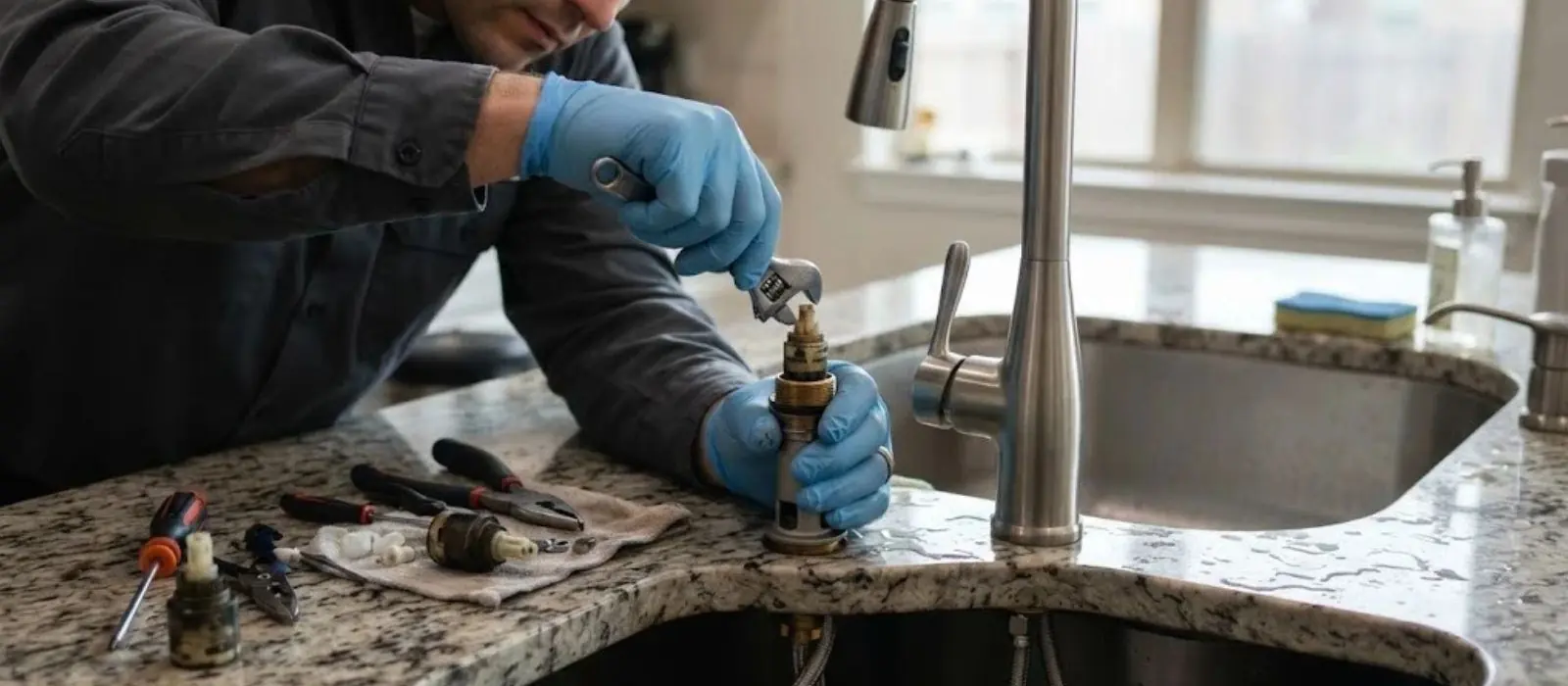
We replace the failed part, then run hot and cold, fill the sink and check every joint with a dry paper towel.
What faucet and sink repair costs
We give a clear price before work starts. These are the factors that decide the number.
What moves the price
- The failed part: a cartridge, a supply line, a shutoff valve and a full faucet carry different parts costs.
- Repair or replace: older faucets with unavailable parts usually mean a new faucet.
- Fixture type: single handle, widespread, wall mount, tub and shower valves differ in labor.
- Access: a tight vanity, a deep cabinet or a stuck fitting adds time.
- Time of the call: nights, weekends and holidays are usually priced differently from a weekday visit.
Describe what you see when you call (860) 397-8103 and we will explain what to expect.
Condos and older Rocky Hill homes
About 39 percent of Rocky Hill's housing units were condos or apartments in 2010, and many homes date from the 1960s to the 1980s. Older homes often have original shutoff valves under the sinks. Those valves may no longer close fully, so the first step of any repair can be a new valve.
In a condo, a cabinet leak can run down to the unit below. Tell your building manager as well as us, and photograph the damage before cleaning up.
Questions homeowners ask
Do you handle faucet and sink emergencies at night or on weekends in Rocky Hill?
Yes. The dispatch line answers 24/7, including nights, weekends and holidays. Tell us where the water is coming from and we book the first plumber who can get to your address. After-hours visits are priced differently from weekday ones, and we give you the price before work starts.
How do I shut off water to one sink?
Turn the two small valves under the sink clockwise, one for hot and one for cold. If they will not turn or keep leaking, close the main shutoff for the house, usually near the water meter or where the line enters the home.
Is a dripping faucet really worth fixing?
Yes. A steady drip wastes water and wears the valve seat, which can turn a cartridge swap into a replacement. It also stains the sink and can hide a larger leak below. Fix it early while parts are cheap.
Can I just tighten the leaking nut under the sink?
A gentle quarter turn on a slip nut sometimes stops a drip. Do not crank a supply line nut or any fitting that is cracked. Overtightening can split a plastic nut or damage the line, and a plumber should replace it.
Should I replace the faucet or repair it?
Repair if the body is sound and parts are available. Replace if the body is cracked, the finish is pitted or the parts cost close to a new fixture. We give you both options and a clear price before work starts.
Do you serve Wethersfield, Newington and Cromwell?
Yes. We serve those towns from Rocky Hill, and the dispatcher confirms availability for your address when you call. See our Cromwell page for how we cover the south side.
Call the 24/7 line, describe the problem, and we confirm what it will cost before any work starts.