
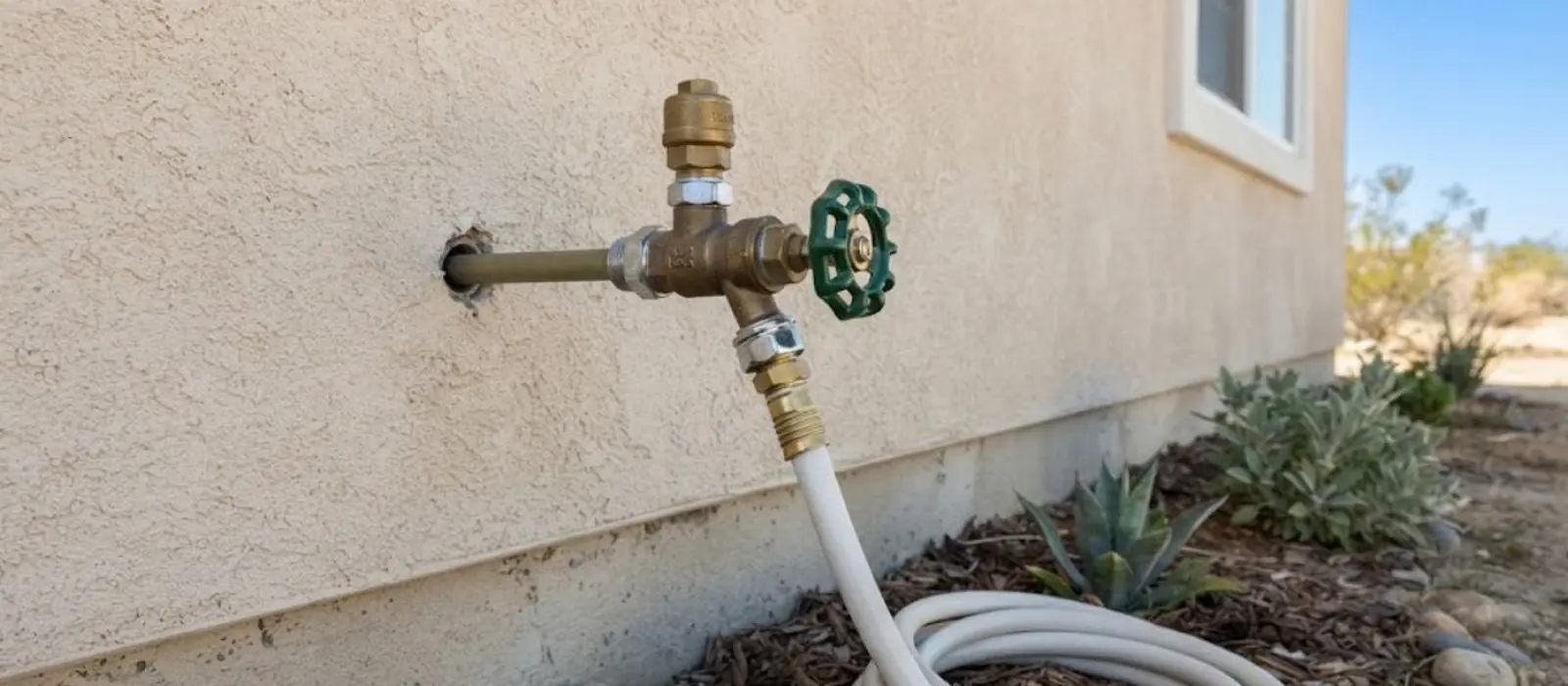
A leaky outdoor faucet is most often a worn washer, a loose packing nut or a cracked valve body. If water drips from the spout when the handle is closed, the washer is worn. If it seeps around the handle stem, the packing is the problem. Both are small repairs. Water showing up inside the house, in a basement ceiling or on a wall, is not.
Outdoor faucets are also the first thing to fail when a Connecticut cold snap arrives. A hose left attached traps water in the faucet, and that water can freeze and split the pipe behind the wall. This guide covers the causes, what you can safely do yourself, how to winterize, and when to call a licensed plumber.
Where the water is coming from tells you the fix
Look closely before you buy parts. Run a hand along the faucet with the handle fully closed and the hose off. The wet spot points to the failed part.
A simple, older hose bib has a rubber washer that presses on a seat. Over the years the washer hardens and the seat roughens. A frost-free sillcock is built differently, with a long stem that places the shutoff seat well inside the heated part of the house. That design is smarter for winter, but it fails in its own ways.
Drip from the spout
The washer or the seat is worn. On a basic hose bib, replacing the washer often stops it. On a frost-free sillcock, the stem and washer assembly is replaced as a unit, and that is easier with the water shut off inside.
Weeping around the handle
The packing nut or packing washer has loosened or dried out. A quarter turn on the nut sometimes stops it. If tightening does nothing, the packing needs replacing.
Water inside the wall or from the basement ceiling
This usually means the pipe behind the faucet cracked or the sillcock body split. Shut off the water to that line and call. Running the hose will only push water into the wall.
Hose bib or frost-free sillcock: how each one leaks
Many homes have one of each, so it helps to know which you have. A frost-free sillcock has a long body that slopes slightly downward and sticks out from the wall.
| Type | Common failure | Usual fix | DIY or plumber |
|---|---|---|---|
| Basic hose bib | Worn washer, loose packing nut | New washer, packing or whole faucet | DIY if the shutoff works |
| Frost-free sillcock | Worn stem washer, split body after a freeze | Replace stem or the whole sillcock | Plumber for wall access |
| Faucet with vacuum breaker | Leak from the breaker cap after a hose was left on | Replace the breaker or the faucet | DIY or plumber |
| Old faucet on corroded pipe | Stuck handle, leak at the wall joint | Replace faucet and short pipe section | Plumber |
What to do right now
Most outdoor faucets have their own shutoff valve inside the house, often in the basement or crawl space, close to the wall where the faucet sits.
Stop a leaking outdoor faucet safely
- Disconnect the hose and any splitter or timer so water has somewhere to drain.
- Find the interior shutoff for that faucet and turn it clockwise until it stops.
- Open the outdoor faucet to let the pipe drain, then leave the handle open.
- If there is no interior shutoff, shut the main valve and call us.
- Check the wall, ceiling and floor near the pipe for dampness. Wet drywall or a stained joist means the leak is inside.
- Do not use a torch or a heat gun on a frozen pipe. Open nearby taps and call.
How a frozen pipe turns a drip into a leak
Water expands as it freezes. When a hose stays on the faucet through a cold night, the water between the hose and the valve freezes first. The ice pushes back into the pipe and can split it, usually a few inches inside the wall.
The split often hides until the weather warms. The ice melts, the pipe leaks, and you see water only when the faucet is used again in spring, or when the ceiling below begins to stain. A leak found early is a pipe repair. A leak found late can mean wet insulation, drywall and mold.
Signs the pipe behind the faucet is damaged
Water sprays from the wall side of the faucet when it is turned on. The faucet hisses with the handle closed. The water meter keeps moving when every fixture is off. Any of these is a reason to shut the line off and call, because a split pipe can release a lot of water quickly.
Our burst pipe repair crews handle split and frozen supply lines, and the first step is always to stop the water.
Winterize outdoor faucets before the first hard freeze
Remove every hose
Take off hoses, splitters, nozzles and timers. A hose left attached is the most common cause of a split pipe.
Shut off the interior valve
If the faucet has its own shutoff inside, close it. This takes pressure off the line during the coldest weeks.
Drain the faucet
Open the outdoor handle so the water between the shutoff and the spout runs out, then leave it open until spring.
Add a cover if you like
An insulated cover helps a basic hose bib, but it is not a substitute for draining the line.
Check frost-free sillcocks for slope
A frost-free sillcock only drains if the body tilts slightly downward. If it points level or upward, water can sit inside and freeze anyway.
Mistakes that cost more later
Common mistakes with outdoor faucets
- Leaving the hose on through the first cold nights.
- Overtightening the packing nut until the handle will not turn.
- Using thread seal tape on the wrong threads and adding stress to an old pipe.
- Ignoring a slow drip that has already worn the seat.
- Assuming a frost-free sillcock cannot freeze.
- Forcing a stuck handle with pliers, which can twist the pipe inside the wall.
When to repair and when to replace
A washer or packing repair is cheap and quick. Replacement makes sense when the body is cracked, the threads are stripped, the handle is stuck or the faucet is more than a few years past its best. A new frost-free sillcock also lets you fix a poor slope and add a vacuum breaker.
Replacing a faucet often means working at the pipe inside the wall, sometimes with soldering or a push-fit connection. If that is outside what you are comfortable with, call. Our faucet repair service covers outdoor faucets as well as sinks.
What affects the cost of an outdoor faucet repair
We give a clear price before work starts. These factors move the number up or down.
What moves the price
- Repair or replacement: a washer is small, a new sillcock is a bigger job.
- Access to the pipe: a basement ceiling is easy, a finished wall is not.
- Pipe material: copper, PEX or galvanized all connect differently.
- Whether the pipe split: wall repair adds time and parts.
- Time of the call: nights, weekends and holidays are usually priced differently.
Photograph any wet area before cleanup. It helps if you decide to file a claim.
Rocky Hill housing and your outdoor faucets
Most of Rocky Hill's housing was built in the 1960s through the 1980s, and about 2,456 units were added in the 1970s alone. Houses that age often have their original hose bibs or older replacements, so a faucet with a stiff handle or a corroded stem is common.
For you, that means looking at the faucet and the pipe behind it before the weather turns, not after. The town sits in an area with Connecticut winters, so plan on draining outdoor lines every fall. For water service questions, ask MDC at (860) 278-7850.
Source type: town planning document, census counts, utility contact page
Water coming through the wall or ceiling?
Shut off the water to the outdoor line or the main valve, turn off power to any wet area if you can do so safely, and call. If water is near outlets or the panel, stay out and call 911 for an electrical hazard.
Questions homeowners ask
Why does my outdoor faucet drip when it is turned off?
The washer inside has worn or the seat is rough. On an older hose bib, replacing the washer often fixes it. On a frost-free sillcock, the stem assembly is replaced. If it still drips afterward, the valve body is probably worn and the faucet should be replaced.
Can a frost-free faucet still freeze?
Yes. A frost-free sillcock puts the shutoff seat inside the heated space, but it only drains if the body slopes down and the hose is removed. A hose left on or a level installation can hold water that freezes and splits the pipe.
How do I know if the pipe inside the wall split?
Look for spray from the wall side of the faucet, a hiss with the handle closed, damp drywall, ceiling stains below, or a water meter that moves with everything off. If you see any of these, shut off the line and call a plumber.
Can I replace an outdoor faucet myself?
A simple threaded hose bib can be a DIY job if the shutoff works and you can reach the pipe. Soldered or inaccessible connections, stuck faucets and any sign of a split pipe are better left to a licensed plumber.
Do I need to shut off the water to the faucet in winter?
It is a good habit. Remove the hose, close the interior shutoff if there is one, and open the outdoor handle to drain the line. A faucet with no interior shutoff should still have its hose removed before the first hard freeze.
Do you repair outdoor faucets in Rocky Hill?
Yes. We repair and replace hose bibs and frost-free sillcocks in Rocky Hill, and our line takes urgent calls 24/7 for leaks inside the wall. We give a clear price before work starts.
Do you serve Wethersfield and Newington for faucet leaks?
We serve Rocky Hill and nearby towns, including Wethersfield and Newington, with dispatch from Rocky Hill. Call and tell us the address and what you see, and we will book the next plumber available.
Call the 24/7 line, describe the problem, and we confirm what it will cost before any work starts.