
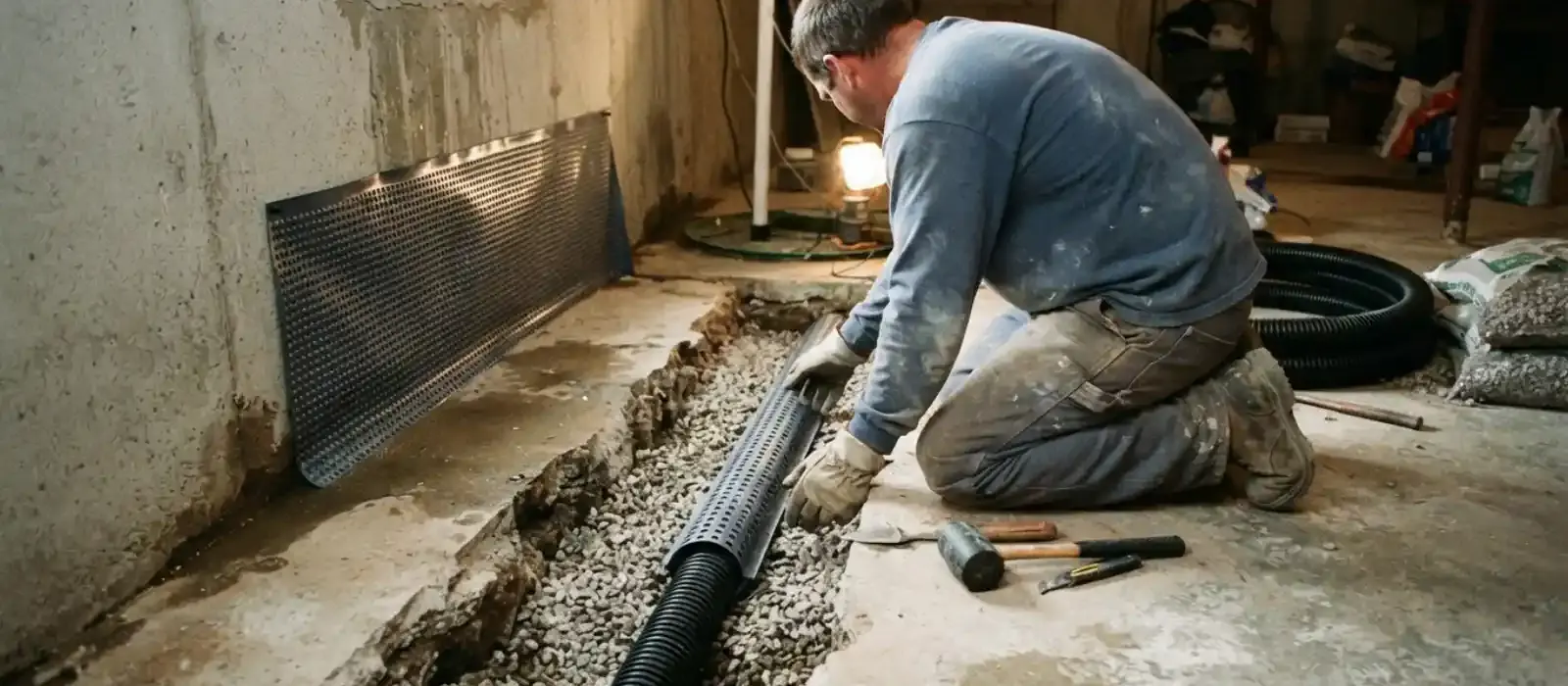
Yes, you can deal with a wet basement from the inside, but only if you pick the right tool. A paint-on sealer slows damp walls and vapor. An interior drain system catches water that reaches the footing and sends it to a sump basin, where a pump moves it out of the house. Neither one stops water from reaching the foundation.
If water is on the floor right now, shut off the power to anything standing in it and call (860) 397-8103. Our dispatch line runs 24/7. The rest of this guide helps you sort out which kind of basement problem you have before you spend money on the wrong fix.
Sealers hide dampness, drains move water
Masonry sealers and waterproof paints form a film on the wall surface. They can reduce chalky dampness and slow vapor coming through concrete block. They do not hold back water that is pushing on the wall, and a film with water behind it will blister and peel.
Interior drainage works on a different idea. It accepts that some water will arrive at the foundation and gives it a path. A channel along the footing collects the water and carries it to a basin, and a pump lifts it out and away from the house.
The choice comes down to what you see. Damp patches and a musty smell point toward a surface or humidity problem. Water that runs in, pools or returns after every heavy rain points toward drainage.
Sealer, interior drain or outside work
Each approach fits a different situation. This table shows where each one helps and where it stops.
| Approach | What it does | What it cannot do | Best fit |
|---|---|---|---|
| Paint-on sealer | Slows surface dampness and vapor through masonry | Hold back water under pressure or stop a leaking crack | Light dampness on dry-feeling walls |
| Crack injection or patching | Seals a single crack in a wall | Fix water coming through the floor joint or several spots | One clear crack with steady seepage |
| Interior drain channel and sump | Collects water at the footing and pumps it out | Keep water from reaching the wall or fix a failing foundation | Water at the floor edge after rain |
| Gutters, downspouts and grading | Move roof and yard water away from the walls | Help with a plumbing leak or a high water table | Water that shows up only after storms |
How an interior drainage system works
A channel along the footing
A trench is opened along the inside of the basement wall and a slotted drain pipe or channel is set in gravel. Water that seeps in at the wall-floor joint drops into it.
Wall weep paths
In block walls, small openings let water inside the hollow cores reach the channel instead of building up inside the wall.
The sump basin
The channel slopes toward a basin set below the floor. Water collects there until a float switch tells the pump to start.
The pump and discharge line
The pump lifts water through a check valve and a discharge pipe to the outside, away from the house. The check valve keeps the pumped water from falling back into the basin.
The slab is patched
Concrete goes back over the channel and the floor is finished. From then on the pump is the part that wears out and needs attention.
Check these before you pay for a system
Many wet basements trace back to water that is sent toward the house instead of away from it. These checks cost little and rule things out fast.
- Downspouts should empty several feet from the foundation, not at the wall.
- Soil beside the house should slope away, not toward the walls.
- Window wells should be clear of leaves and have a working drain or a cover.
- Look for a plumbing source, such as a weeping pipe joint, a water heater or a washer hose.
- Check the sump pump, if you have one, by lifting the float or pouring in a bucket of water.
- Note when water appears: only after storms, only in one season, or all the time.
Humidity is not always a leak
Warm, damp air meeting cold concrete leaves moisture behind. Basements feel clammy in summer for this reason, even with no water entering at all. No sealer or drain fixes that, because the water comes from the air.
A simple test helps. Tape a square of aluminum foil tightly to a bare wall and leave it for a day or two. Moisture on the room side of the foil means humidity. Moisture under the foil means the wall is passing water through.
Condensation on pipes and ducts
Cold water pipes sweat in humid weather and drip onto the floor. That can look like a leak. Foam pipe insulation and a dehumidifier usually solve it.
When a dehumidifier is the right answer
If the foil stays dry underneath and the air feels heavy, run a dehumidifier with a drain hose to a floor drain or the sump. Set it to a moderate level and watch the reading, since a basement does not need to be bone dry.
What an interior system cannot do
It cannot repair a bowed, cracked or shifting foundation wall. It cannot stop water from touching the outside of the foundation. It cannot protect the house if the pump loses power or fails, and it does not promise a basement that never gets wet.
If walls are leaning, cracks keep widening or the floor is heaving, call a structural engineer or a foundation specialist. A pump will not fix that.
The plumbing side of a dry basement
A basement system is only as reliable as the plumbing that carries water out. These are the parts we see failing most.
The sump pump
Pumps wear out from age, stuck floats and debris in the basin. An old pump that has never been tested can fail the first night it is needed. See our sump pump repair and installation page.
The discharge pipe
A frozen, kinked or clogged discharge line sends water right back into the basement. The outlet should drain freely and away from the foundation.
Floor drains
A floor drain that gurgles or backs up is a sewer issue, not a groundwater issue. Our drain cleaning crews clear these lines.
Hidden supply leaks
A slow leak in a wall or under the slab can mimic seepage. A leak detection visit finds it without opening walls blindly.
What drives the cost of basement water work
Prices swing widely with the size of the basement and the scope of the work, so we do not quote numbers in a guide. These are the factors that move the price.
What moves the price
- How much of the perimeter needs a channel, since slab cutting and patching run along every foot.
- Whether a basin and pump already exist or need to be installed.
- Pump size and whether a backup pump is added.
- Discharge routing, including how far the pipe has to run to reach a safe outlet.
- Access, finished walls and flooring that must be moved or removed.
For the plumbing parts, we give a clear price before work starts. Call (860) 397-8103 and describe what you see.
Mistakes that waste money in a wet basement
- Painting sealer over a wall that is actively leaking.
- Running a sump discharge into the sanitary sewer or a floor drain. Ask the Rocky Hill building department and MDC what is allowed before you route it.
- Skipping a backup plan for the pump during a power outage.
- Ignoring gutters and grading because they seem too simple.
- Treating a musty smell with bleach while the cause is still wet.
- Closing off a sump basin with a loose lid that traps humidity and hides a failing float.
What Rocky Hill housing means for your basement
Town planning figures show Rocky Hill added about 3,900 housing units between 1960 and 1990, with 2,456 of them in the 1970s. That means a large share of local basements are four or five decades old. Original floor drains, older sump pumps and aging discharge lines are worth a look before storm season.
The Metropolitan District Commission supplies water and sewer service in Rocky Hill. If you suspect a water supply leak outside your meter, or a sewer issue at the street, ask MDC where its responsibility ends. For discharge routing and any permit question, ask the Rocky Hill building department.
Source type: town planning document, census counts, utility service page
Questions homeowners ask
Can I really waterproof a basement from the inside?
You can control water that reaches the foundation with an interior drain, basin and pump. You cannot stop water from reaching the outside of the wall. Sealers alone help only with light dampness and vapor, so match the fix to what you see.
Do waterproof paints work on a leaking wall?
Not for long. Paint forms a thin film, and water pushing from behind it lifts the film off the wall. Paint can help with surface dampness on a dry-feeling wall. For actual leaks, fix the water path first.
Is a sump pump the same as an interior drainage system?
No. A sump pump is one part. The drain channel collects water along the footing, the basin holds it and the pump moves it out. A basin with a pump but no channel only works where water already reaches the basin.
How do I know if I have a humidity problem or a leak?
Try the foil test. Tape foil to a bare wall for a day or two. Droplets on the room side mean humid air. Droplets under the foil mean moisture is passing through the wall. A dehumidifier fixes the first, not the second.
Who should I call for a wet basement, a plumber or a waterproofing company?
Call a plumber for the pump, basin plumbing, discharge pipe, floor drains and any supply or drain leak. Cutting the slab for a perimeter drain or repairing foundation cracks is separate work. We can help you sort out which problem you have.
Can I connect my sump discharge to a floor drain or the sewer in Rocky Hill?
Do not assume so. Routing rules are set locally and by the sewer provider. MDC provides sewer service in Rocky Hill, so ask MDC and the Rocky Hill building department before you connect anything to the sewer.
Do you handle wet basement emergencies in Rocky Hill at night or on weekends?
Yes. Our dispatch line is open 24/7, including nights, weekends and holidays, and we serve Wethersfield, Newington and Cromwell from Rocky Hill. After-hours visits are priced differently, and you get a clear price before work starts.
Call the 24/7 line, describe the problem, and we confirm what it will cost before any work starts.