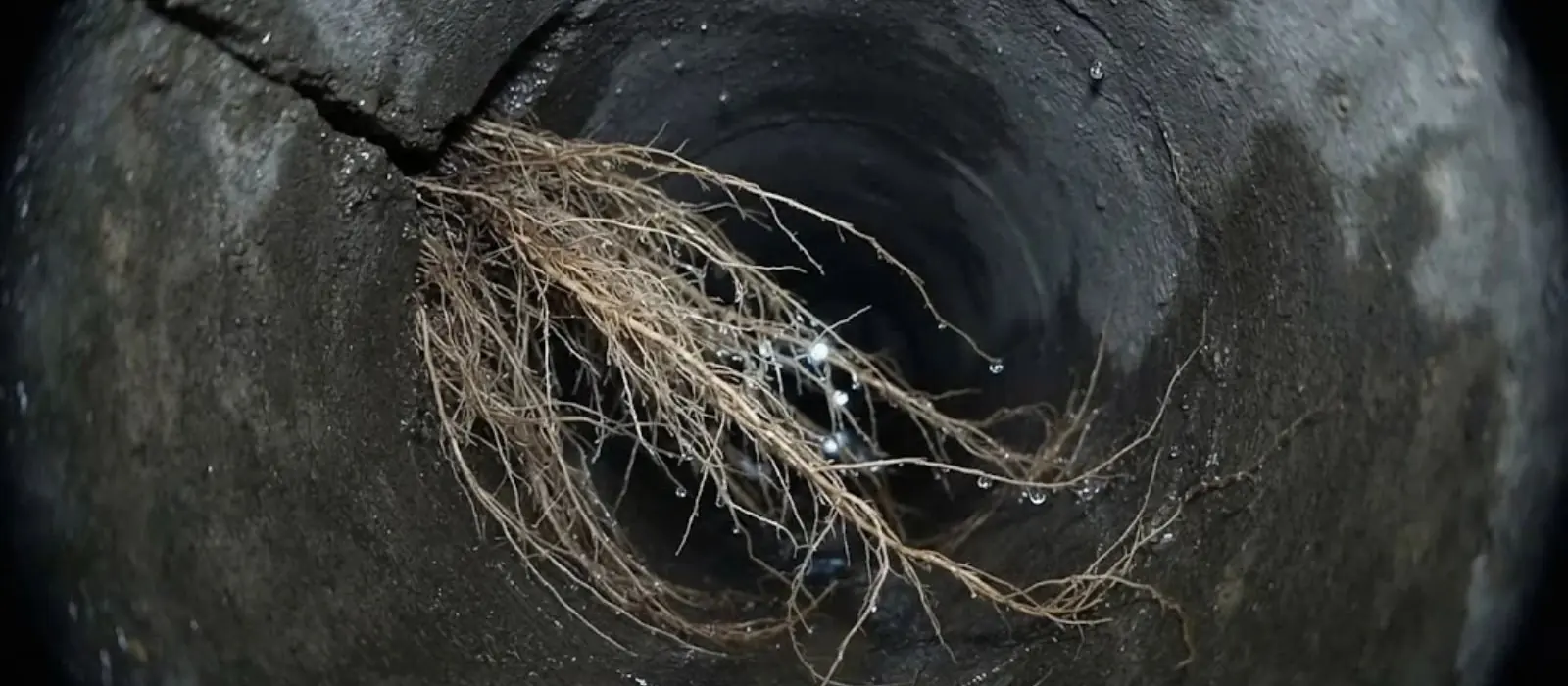
Tree roots grow toward the moisture and nutrients inside a sewer pipe. They slip in through a loose joint or a hairline crack, then thicken into a mat that catches paper and waste. The first signs are slow drains, gurgling and a toilet that bubbles when water runs elsewhere in the house.
A cable or jetter can clear roots, but they return unless the opening is repaired. If sewage is backing up into a tub or floor drain right now, call (860) 397-8103 and stay out of the wet area. Our dispatch line is open 24/7.
Signs roots are in your sewer line
Root problems build slowly and then seem to arrive all at once.
- Several drains slow down together, especially the lowest ones in the house.
- Gurgling from a toilet or floor drain when you run the washer or flush.
- A backup that clears with a snake and returns within weeks or months.
- Sewage smell in the yard or basement.
- A greener or faster-growing patch of lawn along the pipe path.
- A dip or soft spot in the yard above the line.
Sewage on the floor
Raw sewage carries bacteria. Keep children and pets out, do not walk through it barefoot, and wash hands and shoes afterward. Stop using water in the house, since every flush adds to the spill.
Open a window if the smell is strong. If anyone feels ill, call a doctor. Call us at (860) 397-8103 and we will tell you what to do until the plumber arrives.
How roots get in and why they come back
A sewer pipe is a sealed run of pipe segments. Joints can shift as the soil settles, and old pipe can crack. A pinhole is enough. The warm, nutrient-rich water inside is an easy target for a root tip.
Once inside, the root thickens and sends out a mass of fine hairs. Cutting the mass clears the pipe, but the root stays in the gap and regrows. That is why a line cleared in spring can be blocked again in a season or two.
Cable, jetting, lining or replacement
Each method fits a different condition of the pipe. A camera inspection tells you which one applies.
| Method | What it does | Limits | Fits when |
|---|---|---|---|
| Cable machine with a cutting head | Cuts through root mass to open the line | Leaves roots in the gap and may leave a rough wall | Quick relief on a backed-up line |
| Hydro jetting | High-pressure water scours roots, grease and scale | Needs access and a sound pipe | Heavy buildup or a repeat clog |
| Spot repair | Digs down and replaces a short bad section | Only fixes the part that is excavated | One cracked or offset joint |
| Trenchless lining | A resin liner seals the inside of the old pipe | Not for collapsed or badly offset pipe | Pipe is mostly intact with joint or crack entry points |
| Full replacement | New pipe replaces the failing run | Excavation, restoration and permits | Collapsed, bellied or severely cracked pipe |
What a root visit looks like
Describe the symptoms
We ask which fixtures are slow, whether there is a cleanout and how often the line has backed up before.
Clear the line
A cable or jetter opens the pipe so water can flow again. This is the first step, not the fix.
Run a camera
A small camera travels the line and shows roots, cracks, offsets and low spots. See our sewer camera inspection service.
Explain the options
If the pipe is cracked or offset, we explain the choices and give a clear price before work starts. Repair options are covered on our sewer line repair page.
Plan for prevention
If the pipe is sound, we suggest a cleaning schedule. If not, a repair stops the repeat.
Prevention that actually helps
Keep new trees well away from the sewer line. A large tree needs a much wider berth than a small shrub, and willows, maples and poplars are known for aggressive roots. Ask a local landscaper what suits your yard.
If a line has repeated root trouble, scheduled hydro jetting can keep it open between repairs. Chemical root killers are a short-term patch at best. They do not fix the opening and some can harm the tree. A plumber can advise on what is safe for your pipe.
What affects the cost of root work
Root jobs run from a simple clearing to a full excavation, so we do not publish prices in guides. You get a clear price before work starts.
What moves the price
- Whether the job is a clearing, a repair, a lining or a replacement.
- Length and depth of the affected pipe.
- Whether the work reaches under a driveway, sidewalk or street.
- Access through a cleanout and how far the roots extend.
- Restoration of the lawn, pavement or landscaping after digging.
Not sure what stage your line is in? Call (860) 397-8103 and describe the symptoms.
Mistakes that make root problems worse
- Clearing the line again and again without a camera look.
- Planting a tree directly over the sewer path.
- Pouring chemical cleaner into a backed-up drain, which can splash on whoever opens the line.
- Digging in the yard without calling 811 first.
- Ignoring early signs such as slow drains and gurgling.
- Waiting for sewage on the floor before calling.
Digging, permits and who owns what in Rocky Hill
The Metropolitan District Commission provides sewer service in Rocky Hill. Ask MDC where its responsibility ends and yours begins before you plan a repair, because that decides who handles which part of the pipe.
Work that crosses a street or sidewalk needs a Town Street Excavation Permit under Chapter 212 of the town code. It costs $50 per location, requires a licensed, insured and bonded contractor, and needs a Call Before You Dig number. Connecticut law requires a call at least two full working days before digging, and forgetting to call does not count as an emergency. Call 811.
Source type: town code, state law, utility service page
Questions homeowners ask
How do I know if tree roots are in my sewer line?
Slow drains on several fixtures, gurgling and repeat backups are the common signs. Only a camera confirms roots. If a snake keeps hitting something solid at the same spot, roots or a break are likely.
Can roots break a sewer pipe?
Roots usually enter through an existing gap, but they widen it as they grow. Over time they can crack old pipe and push joints apart. Bellied or collapsed pipe is often the result of ground movement, with roots making it worse.
Is cabling or jetting better for roots?
Cabling cuts roots quickly and is often enough to restore flow. Jetting cleans the pipe wall more fully. Neither one closes the entry point, so a camera look matters if roots return.
Will trenchless lining stop roots?
A properly installed liner seals joints and cracks from the inside, which removes the entry points. It does not suit every pipe, and collapsed or badly offset sections need a different fix. A camera helps decide.
Do I need to call 811 before a sewer repair?
If power equipment will dig, Connecticut law requires a call at least two full working days before digging. Call 811. Skipping the call does not qualify as an emergency excavation.
Who is responsible for the sewer pipe in Rocky Hill?
MDC provides sewer service in Rocky Hill, so ask MDC where its responsibility stops. Work across the street needs a town excavation permit.
Do you handle sewer root emergencies at night in Wethersfield or Cromwell?
Yes. Our dispatch line is open 24/7 and we serve Wethersfield, Newington and Cromwell from Rocky Hill. After-hours visits are priced differently, and you get a clear price before work starts.
Call the 24/7 line, describe the problem, and we confirm what it will cost before any work starts.