A tankless water heater warms water only when you open a tap, so there is no tank to run out of hot water and no standby heat loss. Installing one in an older Rocky Hill house is a bigger project than swapping a tank, because gas, venting and electrical needs are different. We handle installation, repairs and maintenance, and our 24/7 line also takes urgent calls.
If your tankless unit is leaking or shut down right now, call (860) 397-8103. If you are comparing it with a standard tank, see water heater installation. If a failed tank is forcing the decision, water heater replacement covers the fast route.
Tankless or tank: how they compare in a real house
Neither type is better for everyone. This is how the main differences play out.
| Question | Tankless | Tank |
|---|---|---|
| Hot water supply | Continuous, up to the unit's flow limit | Limited to the tank, then recovery time |
| Floor space | Wall-mounted, takes little room | Needs a footprint and clearance |
| Gas and venting | Larger gas line and special venting often needed | Existing gas line and vent often reused |
| Upfront work | More complex install | Simpler swap |
| Maintenance | Yearly flush to remove mineral buildup | Occasional flush, anode rod check |
| Failure risk | Heat exchanger and sensor faults | Tank shell leaks |
What a tankless install needs from your house
Three things decide whether tankless works: gas capacity, a venting path and electrical power. A gas tankless unit burns much more fuel at once than a tank burner. The existing gas line may be too small and the meter may need review. We tell you what the line needs, and the gas utility handles anything on its side of the meter.
The unit also needs its own venting, usually sealed pipe through a wall or roof, and a power outlet for the controls. Many Rocky Hill homes built from 1960 to 1990 used chimney venting, so the old flue is often retired when tankless goes in. Ask the Rocky Hill building department what the job requires.
Sizing a tankless unit
Flow rate
Add up the fixtures that may run at once, such as two showers and a dishwasher. The unit must deliver that flow.
Temperature rise
Incoming water is coldest in winter, so the unit must raise it further. Winter conditions size the unit.
Fuel type
Gas units deliver more hot water than electric models, but need gas and venting. Electric units need heavy circuits.
Number of baths
A large home may need two units or a recirculating setup so distant fixtures get hot water faster.
Tankless repair: error codes and common faults
Tankless units tell you what is wrong with a code on the display. The code points to an area, such as ignition, flame detection, venting, a water flow sensor or an overheated heat exchanger. A plumber reads the code and the model number together, since the same code can mean different things on different brands.
Common repair calls include units that shut down mid-shower, produce lukewarm water, or ignite and then cut out. Some are simple, like a clogged inlet filter. Others involve ignition parts, sensors or the heat exchanger. Gas and electrical parts are for a licensed plumber only.
Cold water sandwich and lukewarm output
If water goes hot, cold and hot again when you stop and restart a tap, the unit is reacting to short draw times. If it never gets fully hot, the cause may be a flow sensor, scale on the heat exchanger or a unit that is undersized for the winter inlet temperature.
Flushing and descaling a tankless heater
Minerals from the water settle inside the heat exchanger and slowly choke the flow. Flushing removes them before they cause fault codes.
Shut down the unit
Gas or power is turned off and the water isolated, so no one is working on a live burner.
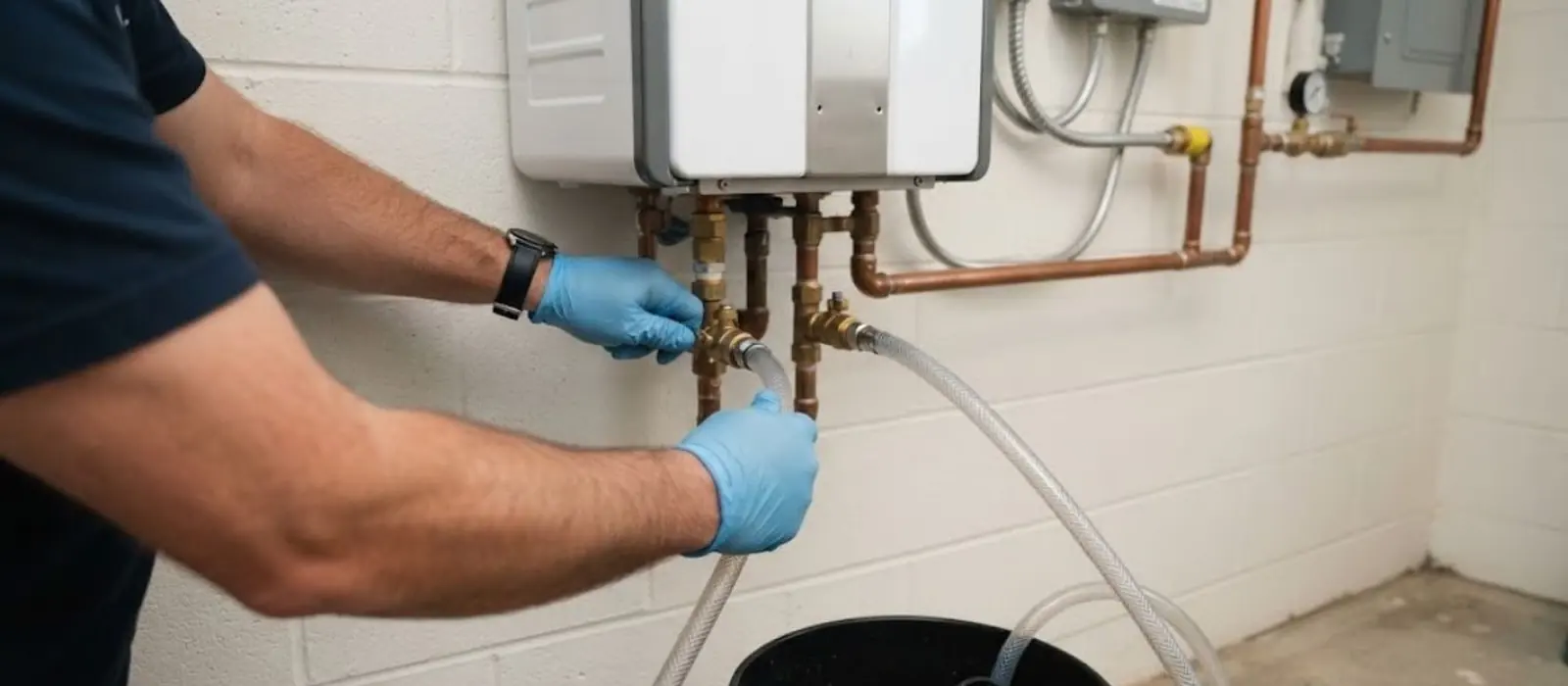
Connect the flush loop
Hoses link the unit's service valves to a pump and a bucket of descaling solution.
Circulate the solution
The solution runs through the heat exchanger for the time the maker specifies.
Rinse and clean the filter
Fresh water flushes out the loosened scale, and the inlet filter is cleaned.
Restart and test
The unit is restarted, checked for codes and verified for steady hot water and no leaks.
How fast minerals build up in your unit
The pace depends on your water. MDC, which provides water in Rocky Hill, does not publish a hardness figure, so test your tap or ask MDC. MDC's lead-safety note also says hot water may have a higher mineral content than the cold supply. For you, that means flushing on the maker's schedule rather than guessing.
If you are in Cromwell or Berlin, your supply is groundwater from the Cromwell Fire District Water Department, a different source from the MDC reservoirs. Ask the district for its latest water quality report and test your tap before sizing a softener or filter.
What tankless work costs
We give a clear price before work starts. The factors differ for install, repair and flushing.
What moves the price
- Installation: gas line size, venting route, new circuits and the model chosen.
- Repair: the failed part, such as a sensor, ignition part or heat exchanger.
- Flushing: unit age, how long since the last flush and ease of access to the service valves.
- Removing the old tank and capping or reusing its connections.
- Time of the call: nights, weekends and holidays are usually priced differently from weekday work.
Call (860) 397-8103 with the model and the symptom, and we give a clear price before work starts.
Questions homeowners ask
How often should a tankless water heater be flushed?
Many makers call for a flush about once a year, and more often with heavy mineral buildup. MDC does not publish a hardness figure, so testing your tap helps. The plumber can suggest a schedule based on how the unit behaves.
Can you convert my tank heater to tankless?
Usually yes, but it is a larger project than a tank swap. It can involve a bigger gas line, new venting and electrical work. The plumber looks at the house first and explains what the conversion needs.
Why does my tankless heater show an error code?
Codes point to an area such as ignition, flame detection, venting or flow. The same code can mean different things on different brands. Give us the model number and the code when you call and we help narrow it.
What should I do if I smell gas near a tankless heater?
Leave the building immediately and call 911 or your gas utility's emergency line from outside. Do not use switches inside. Call us once the building has been cleared and a gas professional has made it safe.
Is tankless worth it for a small household?
It depends. The upfront work is larger, so it rarely pays off quickly for a small household. Lower standby loss and space savings are the main benefits. The plumber can compare it honestly with a tank.
Do you handle tankless urgent calls at night or on weekends?
Yes. The 24/7 line takes urgent calls, including a leaking or shut-down unit. Tell us the model and the symptom and we book the first licensed plumber who can reach you. After-hours work is priced differently.
Do you serve Wethersfield, Newington and Cromwell for tankless work?
Yes. We serve those towns from Rocky Hill, and the dispatcher confirms availability for your address when you call. See our Cromwell page for how we cover the south side.
Call the 24/7 line, describe the problem, and we confirm what it will cost before any work starts.