
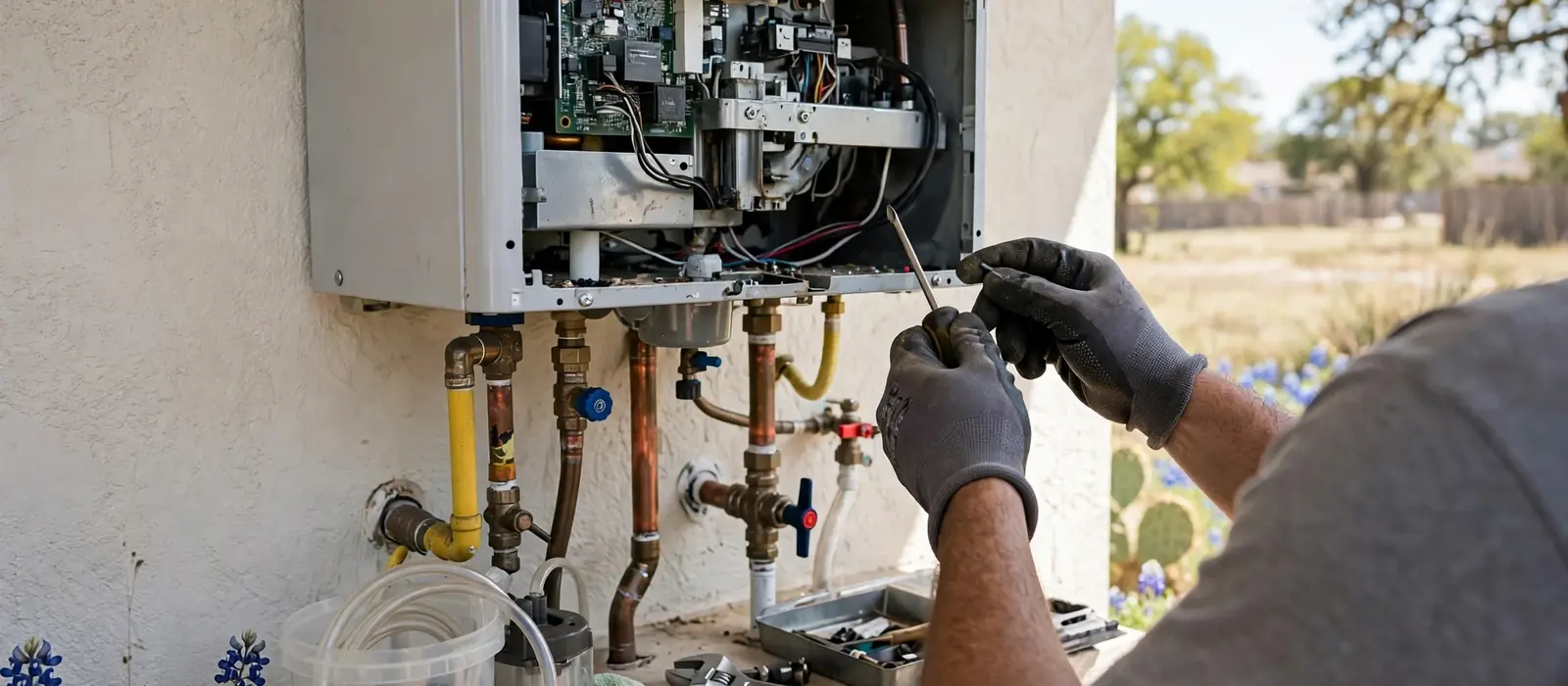
A tankless water heater usually costs more to install than a tank of similar quality, and the gap comes from the work around the unit, not the unit alone. Gas models often need a larger gas supply and new venting. Electric models can need a heavy circuit and spare panel capacity. Typical US installed ranges run from about $2,000 to $7,500 and up, which is typical, not a quote.
The honest answer on payback is that it depends on your hot water use and your starting point. Call (860) 397-8103 with your current setup and you get a clear price before work starts.
What sets the installed price
Tankless installs vary more than tank swaps. These are the factors your plumber is weighing when you ask for a price.
What moves the price
- Gas or electric: gas units need a gas supply sized for a high burner load, electric units need serious amperage.
- Venting: a gas tankless often needs new sealed vent pipe through a wall or roof, replacing the old flue path.
- Condensate drain: high-efficiency gas models produce acidic condensate that needs a drain, and sometimes a neutralizer.
- Electrical: gas units still need an outlet, and electric units can need a new breaker, wire and sometimes a panel upgrade.
- Capacity: a unit sized for the number of fixtures you run at once costs more than a small one that struggles.
- Existing plumbing: new isolation valves, a recirculation setup and a pressure relief discharge pipe.
- Removal of the old tank and any wall space or mounting work.
Gas line sizing, venting and electrical work should be done and checked by licensed trades. Ask for the scope in writing at (860) 397-8103.
Tank vs tankless: where the money goes
The comparison is more useful than any single price. Ranges are typical US figures, not a quote.
| Item | Standard tank | Tankless |
|---|---|---|
| Typical installed range | $1,200 to $3,500 | $2,000 to $7,500 and up |
| Typical life | Roughly 8 to 12 years | Often 15 to 20 years with upkeep |
| Hot water supply | Limited by tank size | Continuous, limited by flow rate |
| Standby heat loss | Yes, all day | Little to none |
| Upkeep | Occasional tank flush, anode check | Yearly flush or descale, filter cleaning |
| Space | Floor space | Wall mount, frees floor space |
Gas line, vent and electrical upgrades
These upgrades are the reason two tankless quotes can differ by thousands. They are also the part you should never try to do yourself. Gas piping, combustion venting and panel work are licensed-trade work, and mistakes can mean carbon monoxide or fire.
If you smell gas at any point, leave the building and call 911 and the gas utility's emergency number. Do not flip switches or look for the source.
Gas supply
A tankless burner draws far more gas at once than a tank burner. The existing line may be too small, which means upsizing pipe, and sometimes a larger regulator or meter is involved. Ask your plumber to check the supply before you buy a unit.
Venting
Most modern gas tankless units use sealed plastic vent pipe, with intake and exhaust running to the outside. Existing metal flue pipe usually cannot be reused. Vent length, bends and termination location all affect cost.
Electrical
Electric tankless units can pull a very large load, and a small panel may not have room. That can mean a panel upgrade, a licensed electrician and a bigger project than the heater suggests.
Flush and maintenance for a tankless unit
Schedule a yearly flush
Mineral scale builds on the heat exchanger and cuts flow and efficiency. A flush with a descaling solution clears it. Many manufacturers recommend yearly service.
Clean the inlet filter
A small screen at the cold inlet catches debris. If it clogs, the unit gets less flow and may show an error code.
Check the condensate drain
On gas condensing models, keep the drain clear and check any neutralizer cartridge as the manufacturer instructs.
Watch for error codes
A code usually points to flow, ignition, venting or scale. Note it and call, rather than resetting repeatedly.
Does a tankless heater pay for itself?
Sometimes, but not always, and the payback is often longer than sales material suggests. The US Department of Energy has said demand-type heaters can be meaningfully more efficient for households that use modest amounts of hot water, and the savings shrink as daily use rises.
Add the higher installed cost, yearly flushing and a possible repair on a more complex unit. For many households the savings come slowly. The better reasons to choose tankless are endless hot water, saved floor space and a longer expected life, not a quick return.
If you want to compare, ask your plumber for a tank price and a tankless price with the same scope and run the numbers against your actual gas or electric costs.
What Rocky Hill water means for the heat exchanger
Rocky Hill gets its water from MDC, which does not publish a hardness figure in the sources we checked. MDC's lead-safety notes say hot water may have a higher mineral content than the cold supply. Because a tankless heat exchanger is small and runs hot, even moderate scale shows up faster there than in a big tank.
This means yearly flushing matters here, and a quick test of your own tap tells you more than a guess. Ask MDC for its latest water quality report if you want the details before choosing a unit.
Source type: water utility report and lead-safety information
Mistakes that raise the cost later
- Buying a unit sized for the lowest hot water use instead of your busiest morning.
- Skipping the gas line check and finding out on install day that the pipe is too small.
- Using old flue pipe that the new unit cannot accept.
- Never flushing the unit, then paying for a repair that scale caused.
- Choosing on price alone without comparing the full scope of work.
Next step
See our tankless water heater page for service details, or water heater installation if you are replacing a tank. We serve Cromwell and Newington as well as Rocky Hill, and the 24/7 line also takes urgent calls.
Questions homeowners ask
How much does a tankless water heater cost installed?
Typical US installed ranges run from about $2,000 to $7,500 and up. That is typical, not a quote. Gas line sizing, venting and electrical capacity move it most, so call for a clear price before work starts.
Why is tankless more expensive than a tank?
The unit costs more, and the install often needs bigger gas pipe, new sealed venting or a heavy electrical circuit. A tank swap usually reuses the existing connections. Tankless is a conversion more than a swap.
How often should a tankless heater be flushed?
Many manufacturers recommend yearly service, and sooner where scale builds fast. A flush with descaling solution clears mineral buildup from the heat exchanger. Check your manual for the interval it states.
Will a tankless heater save me money?
It can, but payback is often slow once you add the higher install cost and yearly upkeep. Savings are larger for low hot water use. The stronger reasons are endless hot water, space and a longer life.
Is tankless work something I can do myself?
Not the gas, venting or electrical parts. Those need licensed trades, and errors can cause carbon monoxide or fire. Leave the install to a licensed plumber and check any permit with the Rocky Hill building department.
Do you install tankless heaters in Rocky Hill?
Yes. Call (860) 397-8103 and describe your current heater and where it sits. We give a clear price before work starts and can talk through gas, vent and electrical needs.
Call the 24/7 line, describe the problem, and we confirm what it will cost before any work starts.